Hashimoto's and Hair Loss: A Client Win and What the Research Says
Oct 14, 2026The message I got today
Earlier this week, a client sent me a message that made my whole week! She's noticing more hair growth and less shedding.
If you've ever watched your hair collect in the shower drain, you know this isn't a small win. Hair loss is one of the most emotionally loaded symptoms I see, and it's one of the most common questions I get from women with Hashimoto's.
So I want to share her story (with her permission, and without anything that identifies her), and then walk through what the research says about hair loss, thyroid disease, and the things that may help.
Her story
She's in her 60s, postmenopausal, and has lived with Hashimoto's and hypothyroidism for a long time.
A few years ago she started noticing more shedding, and it slowly chipped away at her confidence. She became self-conscious about her hair and tried everything she could find, from new products to new supplements to new advice, but none of it moved the needle.
When we started working together, we didn't add another random product to the pile, and instead spent several months looking for the why and working on it with targeted nutrition, supplementation based on her needs, and other supportive strategies.
Today she told me she's seeing a real difference.
Why hair sheds with Hashimoto's (it's rarely just one thing)
Hair loss in women with thyroid disease usually has more than one contributor. A few of the big ones:
- Thyroid hormone itself: Hypothyroidism (low thyroid function,) is well known to affect hair, skin, and nails. With dry skin, weak nails, and brittle, coarse hair being classic features.
- Menopause: Falling estrogen and a relative rise in androgens directly affect the hair follicle, which is estrogen-sensitive. Researchers describe lower hair density, thinner strands, and texture changes during and after the menopause transition. Female pattern hair loss and telogen effluvium (diffuse shedding) are seen more often in postmenopausal women.
- Autoimmune overlap: Alopecia areata, an autoimmune form of patchy hair loss, is associated with thyroid disease and other autoimmune conditions.
- Nutrient gaps: Vitamins and minerals play a role in the hair growth cycle, because hair follicle cells are some of the fastest-dividing cells in the body.
This is why one-size-fits-all hair supplements so often disappoint, because if you don't know which factor is driving the shedding, you're really just guessing...it's like throwing spaghetti on the wall and seeing what sticks.
What the research says about nutrition and supplements
Here's the honest version: the evidence is promising in some areas and thin in others.
Micronutrients matter, but the details are still being studied. A 2018 review in Dermatology and Therapy looked at vitamins A, B, C, D, E, iron, selenium, and zinc in non-scarring hair loss. The authors concluded that deficiencies may be a modifiable risk factor, but that larger placebo-controlled trials are still needed. In other words, correcting a real deficiency makes sense, but megadosing everything does not.
Iron and ferritin: Studies on iron deficiency and hair loss in women are mixed, with some showing a link and others not. A dermatology review from the Cleveland Clinic notes that many clinicians still screen for iron deficiency in hair loss because treatment seems to work better when it's corrected. One important point for women past menopause: low iron isn't explained by monthly periods anymore, so it needs to be evaluated by your doctor to find the cause. Too much iron can also cause harm, so this is one to always test before supplementing.
Biotin: It's the most famous hair supplement, and the evidence is surprisingly limited. A review of the research found that biotin helped in people with an underlying deficiency or specific conditions, but there isn't good evidence it helps people who aren't deficient. Biotin can also interfere with lab tests, including thyroid labs, so tell your provider if you take it.
The takeaway: test, don't guess, because the goal is to find your gaps, not to take everything on the shelf.
Why it takes months, not weeks
Hair grows in cycles and a single growth phase lasts a long time, which means the changes you make today often don't show up in the mirror for several months. That delay is one of the biggest reasons people give up on something that may have been working, so patience and consistency are truly part of the plan.
What we focused on
Every plan is individual, but the general framework looked like this:
- Find the gaps: Reviewing labs and history to see what might be driving the shedding.
- Targeted nutrition: Making sure her diet supported hair growth, including enough protein.
- Supplements based on need: We only used what her picture called for, rather than a cabinet full of guesses.
- Supportive strategies: Working on everyday pieces like sleep, stress, and consistency.
- Coordinated care: Thyroid medication decisions stay with the prescribing provider.
For her, two of the biggest pieces were protein and micronutrients. We increased her protein intake to over 100 grams per day, since hair is built from protein and many women eat far less than they need, and we focused on micronutrient support to fill the specific gaps her body was working with.
When to see a dermatologist
Some hair loss needs a specialist. Get it checked if you notice:
- Round or patchy bald spots
- A receding hairline or loss of eyebrows
- Redness, itching, scaling, or pain on the scalp
- Sudden, heavy shedding
If this sounds like you
If you have Hashimoto's or hypothyroidism and you're tired of guessing about your hair, your energy, or your body, you don't have to keep trying random fixes on your own.
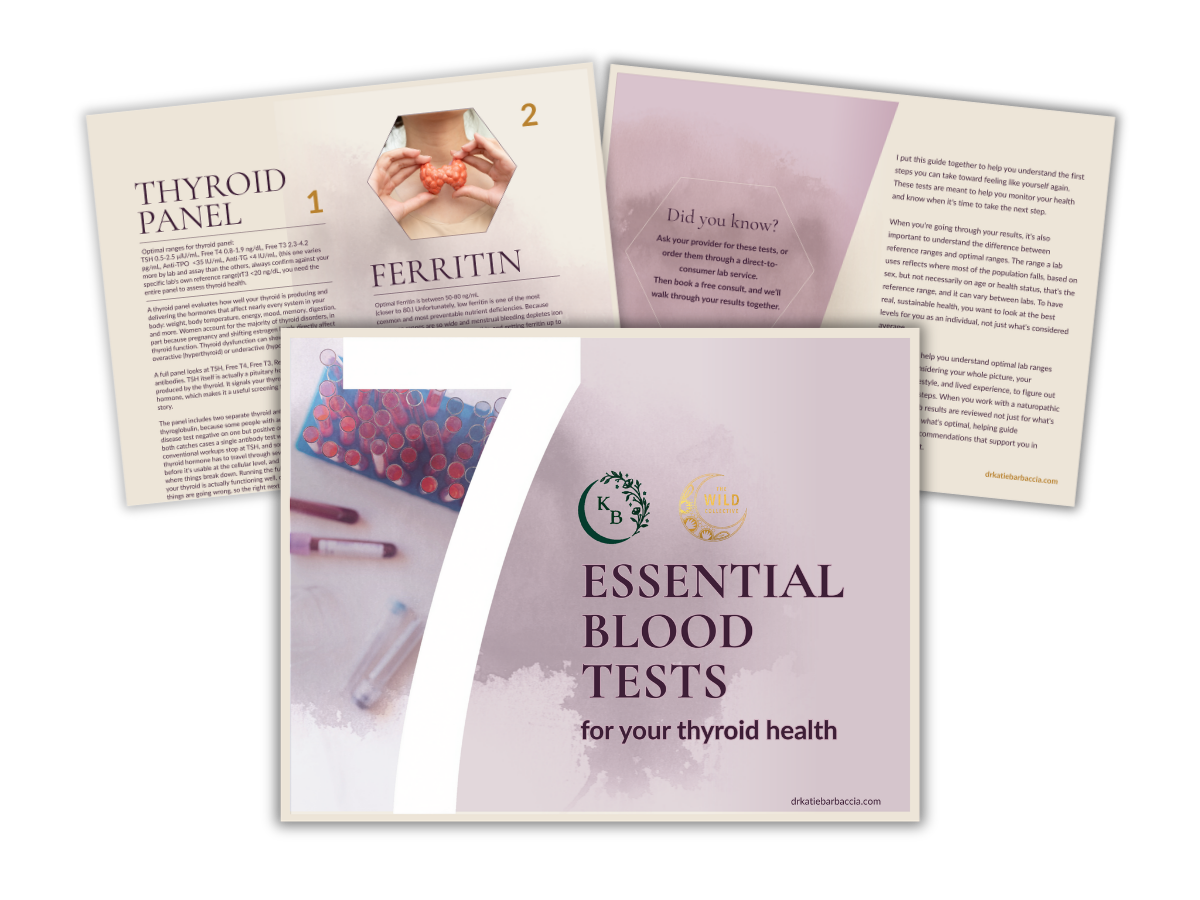
Book a free discovery call to see if working together is a good fit. Or start with my free thyroid lab guide so you know what to ask your provider.
Individual results vary. This post is for education only and is not medical advice. Talk with your provider about your own care.
Sources
- Almohanna HM, et al. The Role of Vitamins and Minerals in Hair Loss: A Review. Dermatol Ther. 2019. doi:10.1007/s13555-018-0278-6
- Gupta AK, et al. Menopause and hair loss in women: Exploring the hormonal transition. Maturitas. 2025. doi:10.1016/j.maturitas.2025.108378
- Lause M, et al. Dermatologic manifestations of endocrine disorders. Transl Pediatr. 2017. doi:10.21037/tp.2017.09.08
- Villasante Fricke AC, Miteva M. Epidemiology and burden of alopecia areata: a systematic review. Clin Cosmet Investig Dermatol. 2015. doi:10.2147/CCID.S53985
- Trost LB, et al. The diagnosis and treatment of iron deficiency and its potential relationship to hair loss. J Am Acad Dermatol. 2006. doi:10.1016/j.jaad.2005.11.1104
- Patel DP, et al. A Review of the Use of Biotin for Hair Loss. Skin Appendage Disord. 2017. doi:10.1159/000462981
Want more? Join the list.
Weekly insights on burnout recovery, nervous system health, and sustainable energy, delivered to your inbox.
Your information stays private. Always.